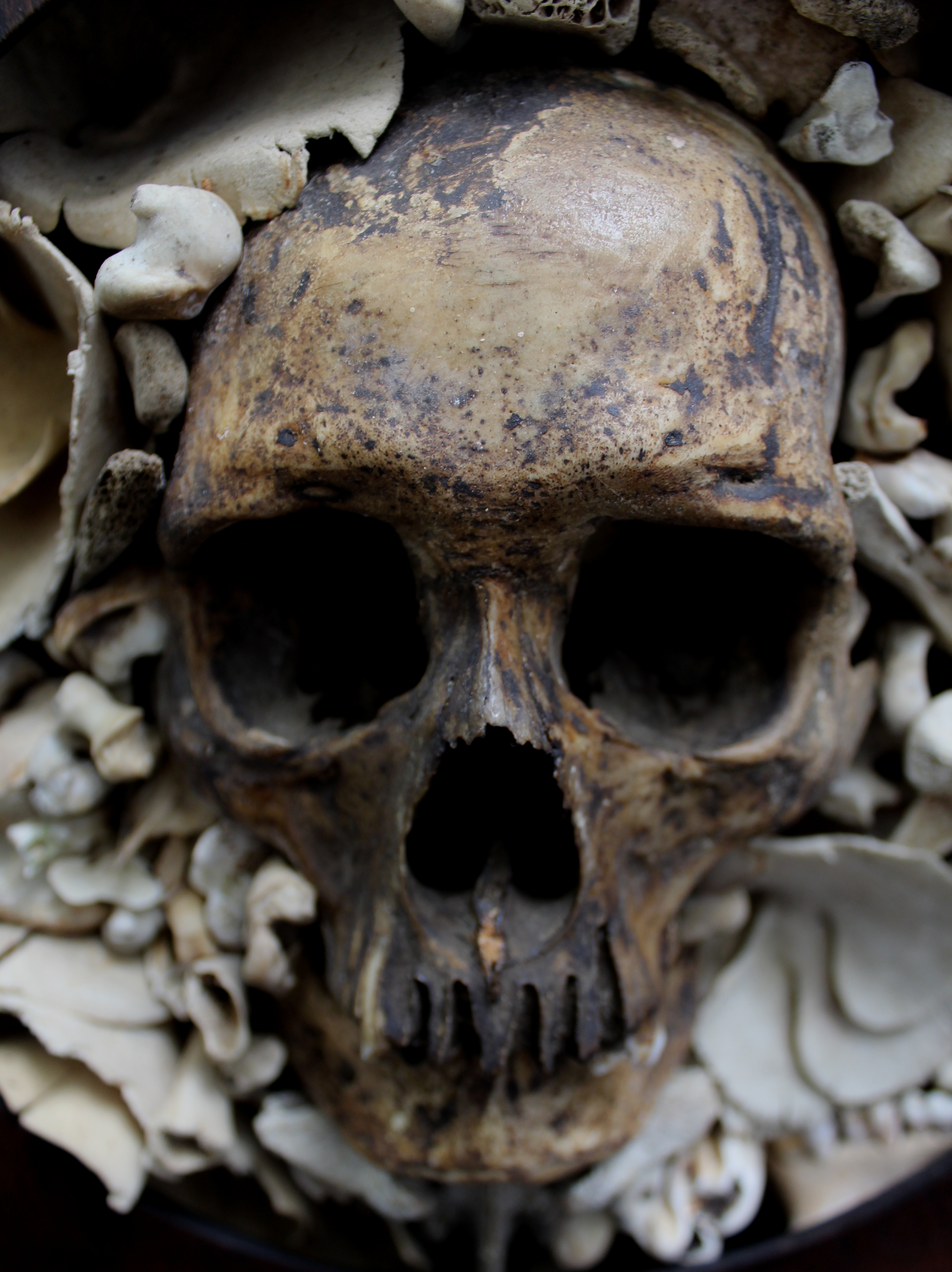
Sacred – A sculpture by New Zealand bone artist – Bruce Mahalski

We can only look upon a human skull with awe.

 Inside a layer of bone which is only a few millimetres thick in places lived a thinking brain, the mind of a person like us.

Imagine the millions of thoughts and experiences this object encapsulated.

No wonder we revere skulls. But we’re scared of them too. Not only do they remind us of our impending death there is also the fear that their former owners might come back to haunt us. For many reasons most of us aren’t too comfortable around human skulls and we certainly don’t want one in our home.

 Today our skulls usually get buried along the rest of us or destroyed completely during the cremation process, and many people don’t have the opportunity to interact with them.

But in the not so distant past skulls often had another life.

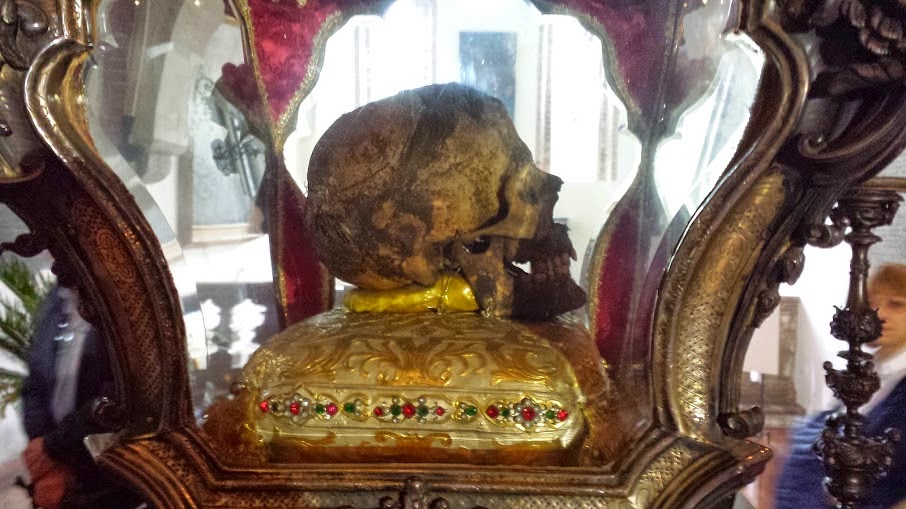
Christians (and other religions) used to keep the skull (or other bones) of religious leaders and venerate them in special containers called ‘reliquary boxes’. By far the largest collection of crania belongs to the Catholic Church and many important religious buildings still contain and occasionally display such relics as palpable touchstones of their faith.

the skull of Peter of Verona

the skull of Peter of Verona

Other cultures have kept skulls as trophies, preserving the heads or skulls of their enemies and displaying them in their houses – or even wearing them as decoration. These trophies were often kept as an insult to the dead person’s mana and a visible warning to their relatives not to come looking for vengeance. Other cultures believed that cutting the head from an enemy and keeping their skull would give them control over the spiritual power of the deceased which they could turn to their own ends in this life.

The indigenous people of Papua New Guinea used to keep skulls of family and friends out of love and a desire to remember their kin. These skulls were considered to hold the spirit (imunu) of those deceased.  If they were well looked after the spirits would continue to help the community as their owners had done when alive. The skulls were often frequently handled and sometimes covered in clay to resemble the deceased person. These ritual objects provided a tangible link between this world and the next and were often consulted for advice or help in times of need.

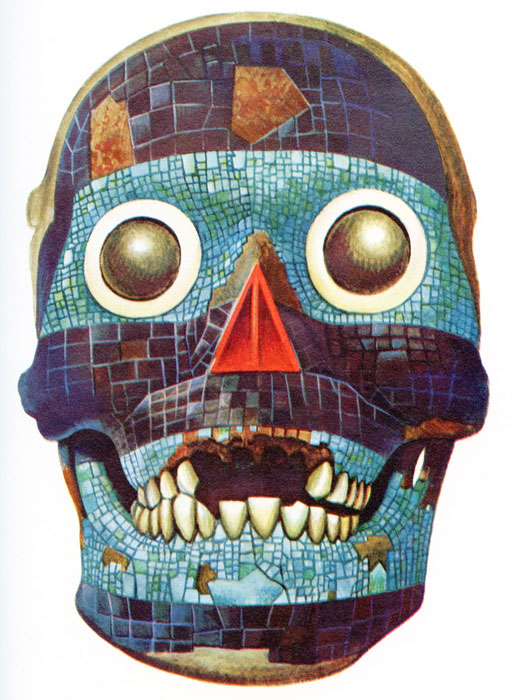
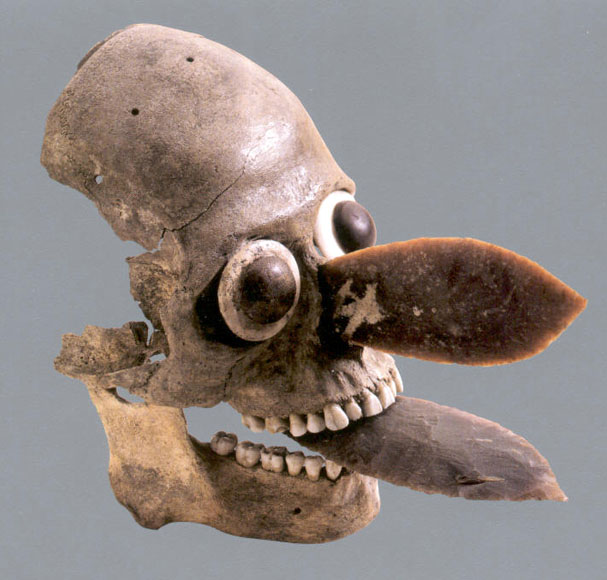
It wasn’t only the natives of New Guinea who liked to decorate skulls; Neolithic crania from approximately 12,000BC have been discovered in the eastern Mediterranean decorated with Dentalium shells. On the other side of the Pacific the Aztecs covered complete skulls in turquoise and other materials. One of the most famous of these is thought to represent the god Tezcatlipoca, or ‘Smoking Mirror’; one of the four powerful creator deities who were amongst the most important of their gods. They also used to cut the facial bones from their victim’s skulls and make ritual masks from them.

Tezcatlipoca, or ‘Smoking Mirror’

Tezcatlipoca, or ‘Smoking Mirror’ – Skull covered in turquoise – British Museum

aztec-skull

Aztec skull mask with flint blade nose/tongue

The Aztecs believed that when a person died their life-force departed from the mortal remains forever. So they had no compunction about using bones in their ritual art. One of the gods, Mictlantecuhtli, the Aztec god of the dead, used bones like seeds to grow new life. The bones were crushed into a powder and inserted into the soil where new humans grew like plants.

There are not many examples of people using human bones for artistic purposes in European history.

One well-known exception is the famous ossuary chapel at Sedlec in the Czech Republic. In the 17th Century woodcarver František Rint used human bones and skulls at Sedlec to make all sorts of decorative sculptures. Mostly they paid homage to the Schwarzenburg family who owned the ossuary – or to himself!

Family Emblem of the Sc

Family Emblem of the Schwarzenberg – Sedlec Ossuary – Czech Republic

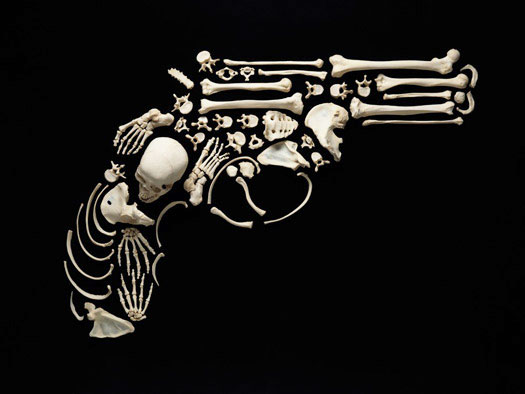
 Another more recent example is the art of Swiss artist Francois Robert who made a number of temporary installations using a human skeleton which he laid out in different patterns and designs, many of which depicted words or weapons.

stop_violence_gun_525

Francois Robert- Skeleton Pistol

Recently I acquired a human skull. Like the other skull in my possession this one was also once ‘owned’ by an old medical man. Up until quite recently everyone training as a doctor had to acquire a real human skeleton so that they could become competent anatomists. Nowadays most medical students use life-like replicas but these are not useful for illustrating the impact of various diseases or congenital malformations.  The skeletons came mostly from sources in India until they outlawed their export in 1985. But many people in India still cannot afford a proper funeral and bodies are often dumped in some convenient place. These bones and others looted from gravesites continue to supply an illegal export trade in human material.

According to estimates, 20 000 – 25 000 human skeletons are smuggled out of India every year through Nepal, China and Bangladesh. The skeletons reach markets in the US, Japan, Europe and the Middle East, mostly for medical institutions. The price for a complete skeleton in these markets ranges from $700 to $1500 depending on the quality and size. In India a full skeleton costs around $350 in the open market. Young Brothers, a Kolkata based bone dealer, sells a human skeleton for $300. While the complete skeletons mostly find their way to medical laboratories in the West, the assorted bones and skulls are used for religious rituals mostly in Hindu and Buddhist dominated areas. For example, as part of their tantric rituals in places such as Nepal and Assam, many tantric adherents drink wine from human skulls.

Illegal Skulls

A police officer in Burdwan, West Bengal, displays a cache of skulls confiscated from a bone factory on the outskirts of Kolka.

I find it slightly odd that not many people are prepared to use real human skulls in art today, although their representations appear absolutely everywhere.

My new skull had been sitting in the bottom of a cupboard for years and was in very poor condition. I decided to use it in a piece of art. I didn’t take this step lightly and I knew I would be throwing myself open to criticism by people who believe I am being dis-respectful.

Much of my work is connected with the idea that humans are an integral part of the natural world and have no claim for any separate status. It is our current ‘disconnectedness’ from nature that is at the heart of so many of our current problems as a species.

 In my opinion all life is equally sacred. I can’t see any spiritual distinction between the bone of a human and the bone of a sheep. I admit that if a bone had a personal connection through birth or friendship (e.g. it was my father’s skull) I might feel differently. But that is a separate issue. I don’t care what happens to my own skull. In fact I’d be happy to see it involved in some new act of creation – or perhaps just sitting on my son’s mantle piece.

The skull I obtained is a mystery. I have been told by the person who gave it to me it probably belonged to a mature woman who probably died at least sixty years ago.

This beautiful structure was part of a living organism and I make my work to honour her previous life force and not to commemorate or celebrate her death. I am also trying to do justice to the life forces of all the other biological material I have used in the work.

Smooth white cup sponge (Corallistes fulvodesmus) Ngawi 2014

Smooth white cup sponge (Corallistes fulvodesmus) Ngawi 2014

To make ‘Sacred’ I installed the skull in a reliquary box or a cista mystica (a sacred casket) made from recycled timber (with the help of Global Wood Rework). I designed the piece so that the skull’s face resembles the corolla of a large flower. The ‘petals’ are made from dried cup sponges(see above) This is a particularly lovely species of sponge which dries out like thick cardboard. I obtained these rare specimens from a beach at Ngawi in the Wairarapa. The other bones and teeth come from cows, sheep,wild pig and ostriches sourced from farms in the lower South Island.

If I hadn’t made this piece both the human skull and the other material would probably been lost to our view entirely. I hope that by preserving these artefacts and bringing them a new life inside a home or a gallery or the internet I am extending them both honour and respect. That is certainly my intent.

Sacred- Skull Art by Bruce Mahalski

‘Sacred’ (30 x 30cm) Human facial bones with cup sponges and bones from cow,sheep, and ostrich in a custom box made from recycled wood. Bruce Mahalski – 2015

Posted in Uncategorized | 1 Comment

Lost in Paradise – Wellington – 2009.

PLANET OF THE SHEEPS

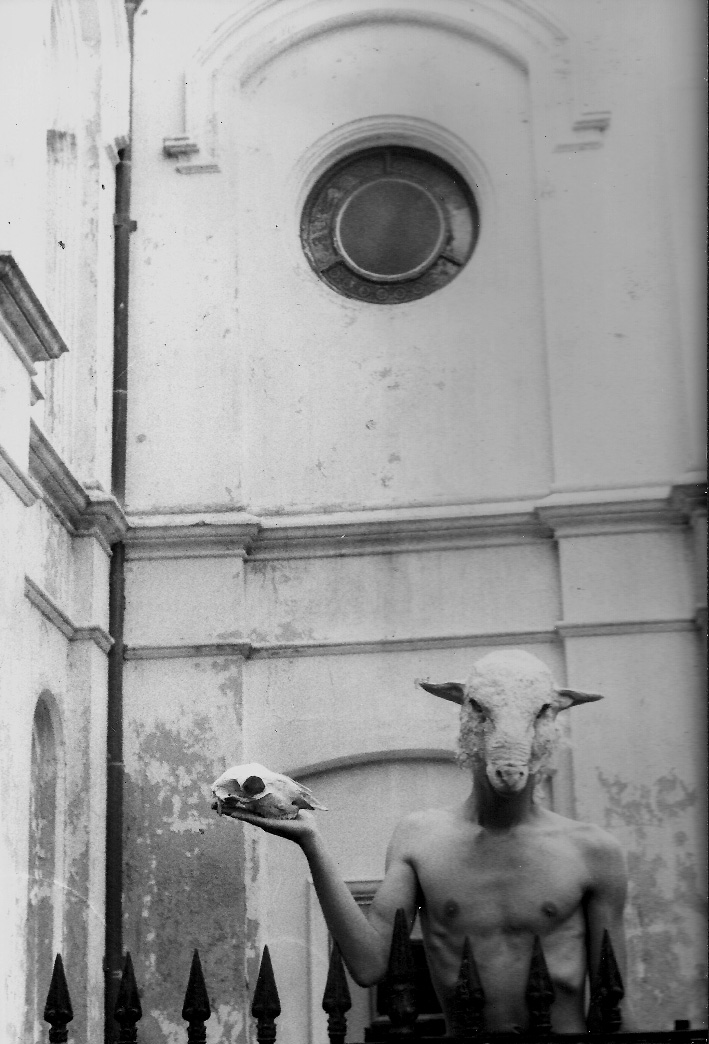
People often ask what the significance of the sheep masks are. What’s my thing with sheep? What am I trying to say?

Really its all a bit of an historical accident.

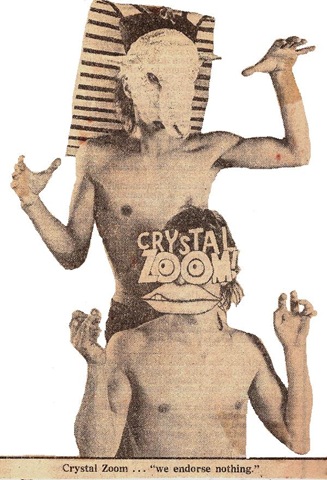
In 1985 I was in a Dunedin band called Crystal Zoom and we had just recorded our first and only single – Uptown Sheep. We were looking for ways to promote the song when someone noticed that a local menswear show had a window display of male mannequins wearing sheep heads. In 1980’s Dunedin this was the very height of bizarre. We approached the manager and asked if he would sell us one of the masks but he wasn’t keen. However he did put us in touch with the person that had made them  – apparently molding them in fiberglass from the head of a dead sheep. After a bit of haggling we settled on $360 for two of them.

            Sheep Mask - Newspaper - Final                               Sheep Shakespeare

              Crystal Zoom – AUCKLAND STAR – 1985                                  Uptown Sheep Single Cover -1985

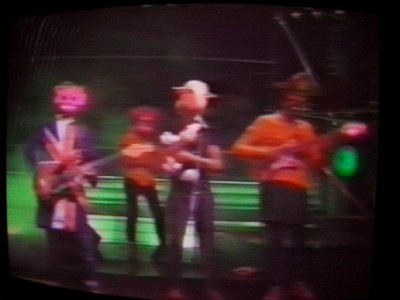
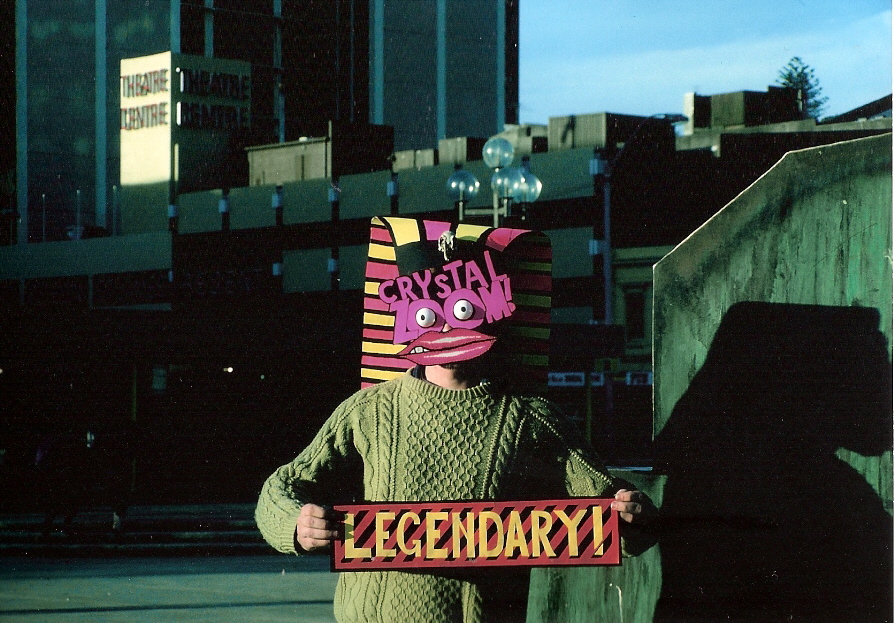
As well as using the masks for the photo on the record cover we also wore them when we ‘performed’ ‘Uptown Sheep’ for a TV music show called Shazam. We had signed a contract to appear as a band but at the time Mike Weston and I had just moved to Auckland and the band was two members short. It didn’t matter much. We were wearing masks every time we played anyway so who was to  know? It also didn’t matter that they couldn’t play either because we only had to pretend to play the song and were determined to do that as badly as possible.

Sheep- Crystal Zoom (comp)                 Crystal Zoom on Shazam – 1985. Mahalski wearing sheep mask.

Later on when the band broke up I got one of the masks and Mike grabbed the other one. Some years later he  was kind enough to give it to me.

In 1996 Te Papa organized a competition to promote an exhibition of photographs by the internationally renowned Magnum Photographic Collective.  The competition brief was to take a photo that captured something about New Zealand and there if there’s one thing that has always screamed ‘kiwi’ to me – it’s sheep (sorry kiwis!).

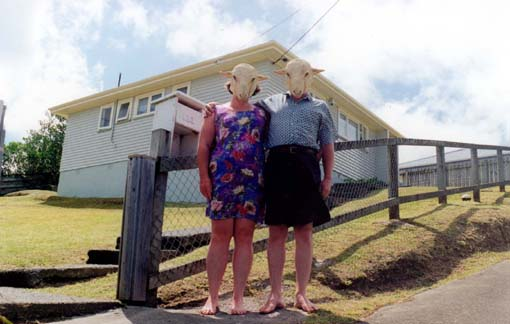
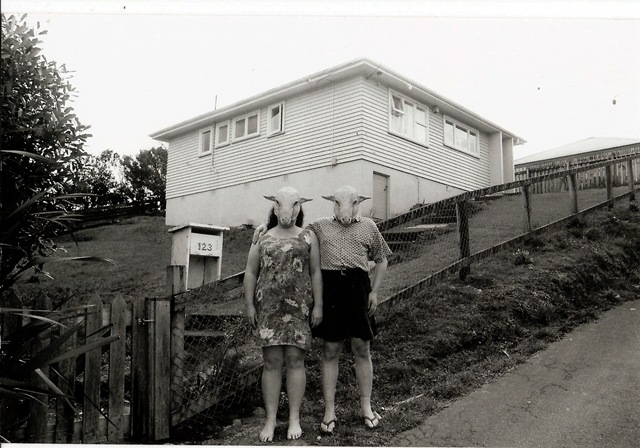
I went round to a friend’s place one summer weekend and persuaded the two of them to pose in front of their house wearing the masks. Believe it or not they were actually wearing those clothes and I didn’t tell Carey to pull his shorts up like that! But their house just didn’t work as a backdrop. Luckily we soon found the perfect building just around the corner. Not only was it the absolutely archetypical NZ state house – it also had the very cool letterbox number 123.

I took a series of colour photos and entered the best one in the competition. There was only the one main prize – which of course was won by a picture of a cabbage tree  or a nikau palm–I forget which.. – However my sheep head picture was one of the ten runners up and a framed copy hung in Te Papa’s first floor foyer for almost a year.

Saved pics from 2006 124

                                                Carey and Catherine – 1996- the first colour version

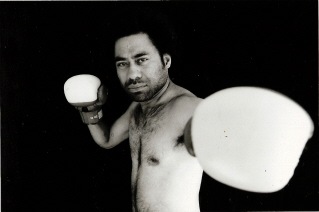
In 2005 I organized an exhibition with Stefano TeVega at the Wellington Art Centre (Toi Poneke ) where we both had studios. We were both big Warhol fans and decided to promote the show by recreating a famous poster of  Andy and Jean Micheal Basquiat posing as boxers. Sadly the pictures we took of ourselves dressed up as boxers didn’t’ turn out too well. To tell the truth Stefano’s looked great but I thought I looked fat. We needed another idea fast.

Stefano TeVega(com)

                                                                  Artist Stefano TeVega – 2006

I’d always liked the statehouse sheep-head picture – it wasn’t called ‘The Happy Couple’ yet –  but thought that the colour detracted a bit and it might be a more successful image if I re-did it in black and white. So I went back to Carey and Catherine  and persuaded them to put those clothes and masks back on again.

  Sheep - The Happy Couple (n)

                                                         The Happy Couple – Wellington  -2006

The second black and white version is more contrived than the first image (because I made them put on the same clothes) but I prefer its overall look and composition.

I used the picture for the posters for the show and people  seemed to like it. It was also fun and easy taking photos using the sheep heads so it seemed like a good idea to do a few more of them.

So what’s the point of the show – if there is one?

It’s really up to the viewer to decide what the photos mean to them. The masks are simply made but extremely evocative. Sometimes they make the wearer look like an Egyptian god or a satyr or a character from The Magus. Sometimes they look friendly – at other times menacing. The slightest tilt of the head has huge impacts on the emotional tone of the photo. There have been comparisons with the American gothic tradition but I do not think it was a conscious influence. I am sure other people have done similar work but I have not seen it.

I have done work with masks before. As I mentioned Crystal Zoom started wearing masks in an attempt to separate our public musical personalities from our private ones . But it’s hard to play wearing a mask and they do set up a barrier between the band and the audience.

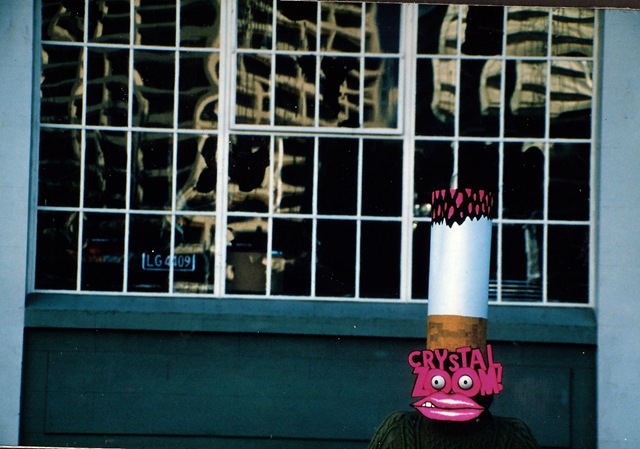
Cystal Zoom - Aotea Square - 1985

                                   Yoh from Crystal Zoom in front of a car park in Aotea Square –1985

                                           (Note holes in the windows after the Queen Street riot)

If there is something dark about the pictures it might be because I like my pictures printed pretty black. Yes – I do believe that the human race is on a fast track to extinction and a lot of my work does comment on this but the sheep head pictures are not my usual heavy warning signs.

They are a lot more playful than that – sometimes there may be some sort of comment intended but mostly they are what they are – pictures of people wearing sheep masks.

Sheep Farm(com)

                                                                  Mother and son – 2009

Contact – Ron Eskamp – the Exhibitions Gallery, 154 Featherston Street, Wellington.

Email – ron@exhibitionsgallery.co.nz

Website – www.exhibitionsgallery.co.nz

Phone 04 499 6356     Mobile – 021 062 2072

© Bruce Mahalski – 2009

Note – All artwork and photos by Bruce Mahalski except Auckland Star Photo (unknown) and Crystal Zoom single cover (Photo

Posted in Uncategorized | Leave a comment

Environmental Exhibition – Wellington – 2010

Work by Bruce Mahalski, John Badcock, Lex Benson-Cooper and Debra Britten.

July 30th  –  August 15th, 2010.

I started collecting shells, fossils and bones when I was very young. My parents were both scientists who had collections of their own and we travelled quite a bit overseas so there were always opportunities to pick up interesting stuff. Once my mum even tried to send a weaver bird’s nest to New Zealand when we were on holiday in Africa  but customs weren’t too keen on letting it into the country! Most of my collection I found myself on beaches or roadsides.  Some people might consider it ghoulish to collect bits of dead animals but to me it isn’t about death – it’s about life. Like a sympathetic magician I hope that by possessing  an animals bone a little bit of its life force will rub off on  me. It’s also a tribute – a form of recycling – a lot of these things are just too good to leave lying around and I have to take them home.

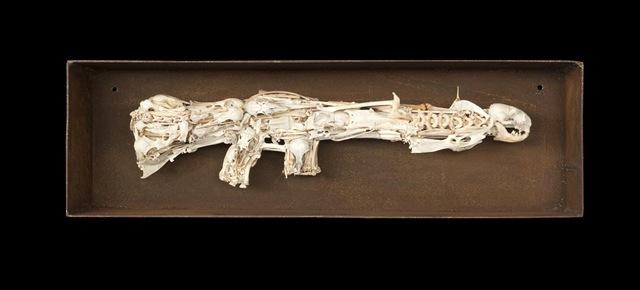
For a long time I didn’t think about using any part of  my collection as raw materials for my art practice. I put the best of my pieces in display cabinets and keep the rest in boxes. The first time I used some of my bones in making an object was for the show – Full Spectrum Dominance – at the Mary Newton Gallery in Wellington in 2002. A large part of the show was a collection of $2 Shop toy guns which I had tried to strip of their negative associations by  instilling them with new beauty and life.  One of these was  Bone Gun#1 – a toy M16 rifle completely covered in bones. It was such a joy to  that I soon made another – Bone Gun#2 (see below).

Bone Gun #2

20 x 70cm

Bones attached to a toy gun

(Comes in purpose built metal case)

2007/8

Bone Show- Bone Gun cf case (Medium)

‘Environmental’ will be the first time this piece has been exhibited. It comes in a rusted sheet metal case (not shown) especially made for it by local artist and stone man – Carl “Carlucci’ Gifford.

When my Wellington art dealer, Ron Eskamp told me he was planning a a show with an environmental theme I suggested making a series of work that began where the Bone Guns left off. Happily Ron was  quick to approve of the concept. I could have continued to predicate my bone works on military apparatus but I didn’t want to repeat myself any more than necessary.   For some time I could not think what to make out of bones and then I realized that I didn’t need to make anything at all. I could just layer bone on bone to achieve interesting textural effects. I immediately ramped up my bone collecting efforts and put the word out among my friends to grab any interesting specimens they saw.

Bone Show- Bone Gun (Medium)

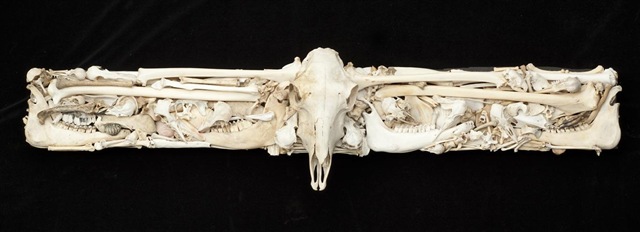
Lintel #1

(to be hung over the top of a door frame)

13 x 1050cm

Layered bone and shells on Matai plank

2010

Bone Show - Lintel (Medium)

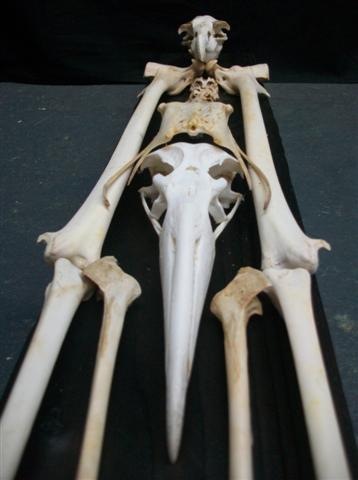
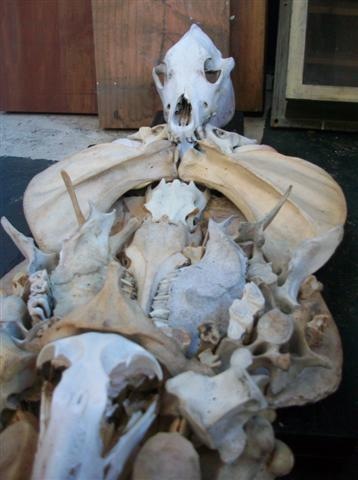
This was the first piece I made specifically for this show. I didn’t originally intend to make a lintel or indeed to make anything symmetrical. I was only planning to layer bone on bone as in the detail pictures below. However  the piece soon took on ‘a life of its own’ and acquired a Viking/Pacific look I had not anticipated.  It contains sixteen skulls including those of a sheep, a hawk, a duck, a hedgehog, a penguin and a Chatham Island Weka and many other bones including those of moa, seal, cat and wallaby.  The bones are attached  to a plank of 150 year old Matai timber (as are many of the other pieces)  which  I picked up from a skip opposite my old studio in Abel Smith Street. An old colonial cottage was having (an illegal) refit and a lot of good stuff had been dumped including two very old mummified cats which I also grabbed for some future use.

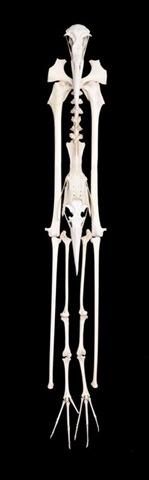
Bird Man #1

15 x 1180cm

Bird Bones attached to plank of Ponderosa Pine

2010

Bone Show - Bird Man (Medium)

I had finished nearly all of the work when I found a box of albatross or mollymawk bones I had forgotten about in the attic.  It’s hard to tell an albatross form a mollymawk – particularly when its not in exactly tip-top condition! It was the day I  was going to see Ron at the Exhibitions Gallery show him photos of the work for the show.  I decided it’d be nice to have one more work and quickly laid out some of the  bones on a plank of ponderosa pine and took a photo. Ron decided it  was his favorite  so I decided I’d better actually put it together for real. As well as duplicating parts of bird/human anatomy the piece also references the ‘cult hooks’ of Papua New Guinea and the bird man culture of Easter Island (Te Pito No Te Henua).

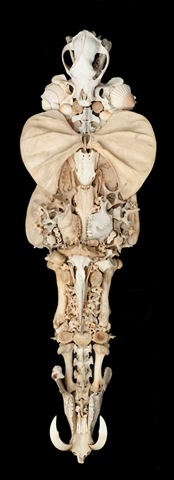
Cult Hook #1

30 x 1200cm

Bones,shells and fossils attached to  a framework of Ponderosa Pine

2010

Bone Show- Cult Hook (Medium)

This piece is the largest and most dynamic of the series and contains the bones of many large animals including those of pig, seal, dog, dolphin,human, sheep and albatross (or mollymawk) – as well as local  fossils and sea shells. Attached to a background of Ponderosa pine using glue and rods it evokes the cult hooks found in the men’s houses of Papua New Guinea. A hook at the top connects the sculpture to the house’s rafters and another at the bottom is used to hang equipment and offerings to local spirits’.  These ceremonial hooks influenced the success of war, hunting and garden cultivation, as well as helping to ward off disease.

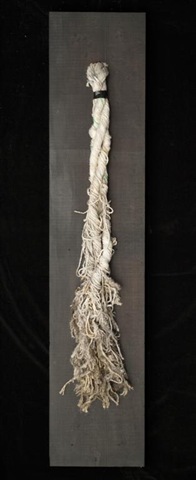
Whale Rope

24 x 1015cm

Length of rope emerging from a piece of old table –top

2010

06 (Medium)

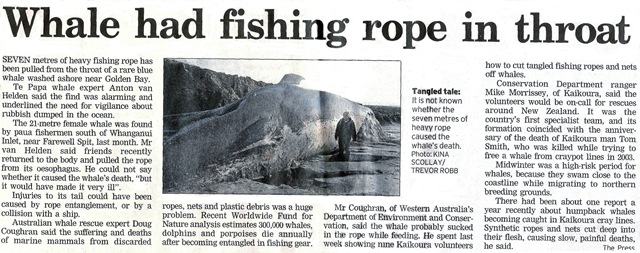
I have a long association with the Island Bay Marine Education Centre and while I was there one day Marco Zeeman showed me a length of rope which had been brought along by two local conservationists, Haydon & Suzanne Miller. Apparently it was part of a seven metre long length of rope they had recovered from the throat of a dead female blue whale that washed ashore in Golden Bay in 2009. It is speculated that it may even had caused the death of the whale. The piece of rope disappears through a hole into a plank from an old hardwood table top. By ‘turning the rope into art’ I hope to spread the sad message that the ocean is simply drowning in our crap and its  high time we all  cleaned up our acts. If this piece does sell I intend to donate my part of the proceeds to some of the main anti-whaling groups.

 Whales - dead blue whale - DOM 13.6.09


Skull Rack #1

28 x 1000cm

Three sheep skulls attached to Matai Planks using metal rods

2010

Environmental- Skull Rack (2) (Small) Environmental-Skull Rack detail (Small)

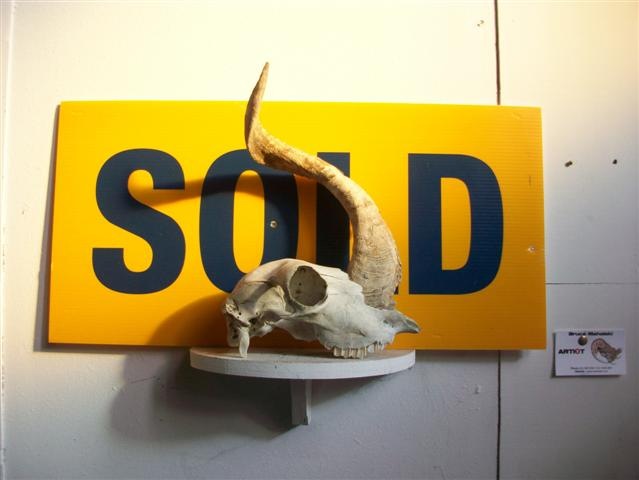
Skull Rack #1 is inspired by the skull racks of Papua New Guinea where the skulls of dead foes and relatives are preserved in the  men’s houses in racks or shelves.  Despite my comments about the life affirming nature of bones I do have to admit to also seeing a lot of beauty in decay.  The top skull is an amazing example. Despite the fact that it is from a ‘common’ animal I think it is one of the most amazing skulls I have ever seen. I was lucky enough to be given it  on a recent trip to Waiheke Island by Helen Aldridge who also gave me some other excellent bits  and pieces including a mummified kingfisher. The skulls float out 12 cm from their wooden base on thin metal rods.

Three Heads (Triptych)

Head#1

80 x 80cm

2008 – 2010

Gloss/Acrylic Paint/Sand

Environmental - Head One (Small)

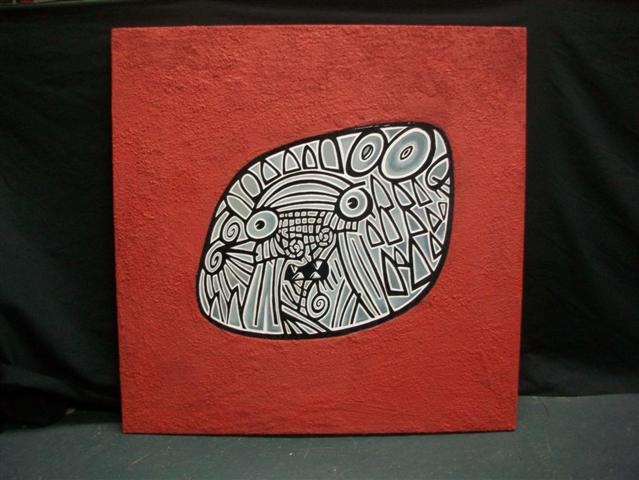
This is one of three heads that make a vertical triptych. I actually started painting these heads a couple of years back when I intended to do a series of works based on drawings that I had done when I was five. My mother had just found the old scrapbook containing the drawings and I thought they were more lively than anything I had done since. I am pretty sure the original drawing was inspired by a carving which I saw on a school trip to Otago Museum. I never completed the series because I had trouble transforming the drawings into paintings and for a while I abandoned the heads when I had trouble resolving the backgrounds.  My recent interest in building up layers of texture enabled me to find a way to contrast the hard gloss of the faces with the softer colors in the background and I decided to finish the triptych in time for the current show.

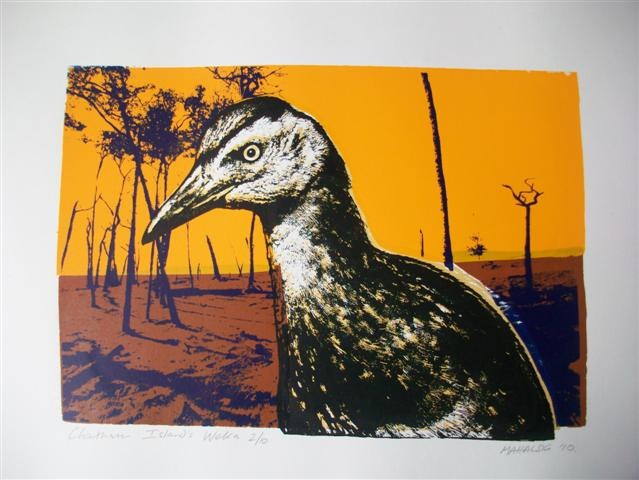
Chatham Islands Weka

50 x 70cm

Limited edition screen-print by the artist on 350gsm paper(10 prints)

2010

Environmental-Weka Screen-print (Small)

A five colour screen-print on paper based on two photos taken on a trip to the Chatham Islands in 2008. I took the photo of the weka in the foreground but my friend Stephen Robinson took the background picture of the trees.  We were out by the old airport near the bush containing the most famous dendraglyphs (carvings on living trees) and the quality of the light was so intense the scene is forever burned in my brain!  Steve and I  ran around taking photos like crazy but I lost most of mine when I loaded the stick from my new digital camera into the computer instead of routing the pictures through the camera.  No two prints in the edition of ten are exactly the same with slightly different tones and offsets across the edition in keeping with my new ‘more painterly’ screen-printing style.

Environmental – Exhibitions Gallery – Wellington – July 29th – August 15th – 2010

www.exhibitionsgallery.co.nz

www.mahalski.com

Studio Pictures

Enviro-Studio - July 2010 (Small) Enviro-Studio 4 (Small)

Environmental - Birdman(closeup) (Small) Enviro-Studio 3 (Small) (Small) Enviro-Studio 5 (Small)

Posted in Exhibitions | Leave a comment

Interview with Bryce Kowalski – Critic – 1988.

Long time contributor to Critic (Otago University’s student paper) – under this pseudonym (and many others) Bryce has just left Dunedin. Before his departure we – at Critic- thought it might be interesting to talk to the man about his politics , his music and his new cuddly toy. (Editor’s Note – I have made one or two changes from the original interview to make the thing more relevant and readable).

INTRODUCTION

CRITIC – Where are you from originally – they aren’t too many ‘Kowalski’s about?

BRYCE – Here of course – Dunedin. You think I shifted here from Auckland or something?

CRITIC – I know that you went overseas a lot when you were young. Did these travel experiences leave you with any lasting impressions that have continued to impact on your life and work?

BRYCE – Naturally! My parents both worked for the University and they used to travel a lot. Until I reached the age of 16 I was pretty blasé about it all but that year(‘79) I spent a lot of time on my own doing various jobs in different parts of England and also went to Germany for a while. It was quite liberating to be treated as an adult by the people I worked with and I grew up pretty fast that year. I think that seeing other countries only made me appreciate this one more. In some other places I’d probably be one of the first against the wall as an obvious deviant and trouble-maker.

CRITIC – So what do you think are the main issues in the world today?

BRYCE – Getting rid of the cold war would be nice – it’s even starting to look like it may happen. The main reason I oppose war is that it’s just too hard on the planet. Once we’ve got the major powers talking to each other again and the nukes are gone or cut back we can then look at fixing some of the other major problems – starting with the environment.

CRYSTAL ZOOM! (1983 – 85)

CRITIC- You’ve been involved with various bands now for a number of years – starting with the somewhat ‘infamous’ Crystal Zoom! Tell us a bit about that?

BRYCE – A group of us had been talking about putting a band together called Crystal Zoom for a long time but in the years before we actually started playing we out up a ton of Crystal Zoom! graffiti up all over town ( and on the side of barns on State Highway One between Dunedin and Christchurch). We figured if people had heard of us they would think we were ‘BIG’. So we had the name itself long before we actually got the band together. There’s a funny story behind the name but I probably shouldn’t tell it here- I might get in trouble.

To start off the band was a basic four piece with me singing (shouting) Mike (Wilde) Weston on guitar, the incomparable Eric Neuman on bass and Nathan McConnell – later Nick Niell -on drums.. We had grown up with a lot of the so-called ‘Dunedin Sound’ – mostly a group of bands influenced by sixties American guitar music – but their style just wasn’t our cup of tea. Like a lot of new bands we started playing punk and thrash(both of can cover a multitude of musical sins) but gradually we go better and more versatile. We had gone out of our way to set ourselves apart from the prevailing ‘sound’ and for a while it was hard to get gigs so we started setting up our own at Coronation Hall in Maori Hill ( earlier ‘Punk’ bands like ‘The Enemy’ had done the same thing). We had absolutely no scruples and would play with anyone – The Mockers – Motorhead – Gamaunche.
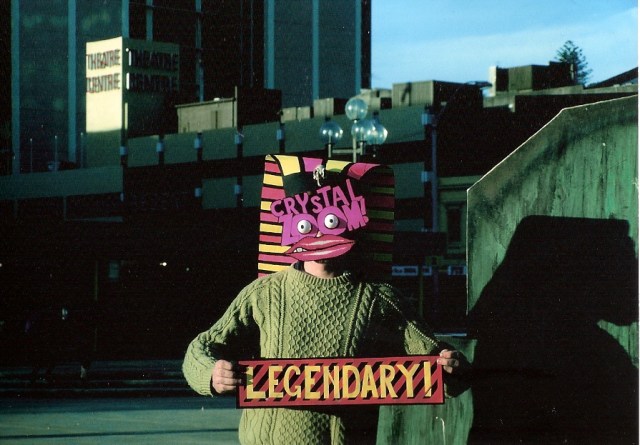
Our ‘difficult’ approach turned off some of the cooler crowd .One well known musician friend said that he would never speak to me again after we played with The Mockers (which we did on several occasions over the years) and he never did again. We were completely brazen about promoting ourselves and would try and get into the Otago Daily Time’s Music Column every week and Rip It Up every month – even if we had to make something up. One time I put out this press release saying that we had all come out as New Zealand’s first all-gay band but the music reporter at the paper said that I was obviously drunk (not true) and wouldn’t use the story but other music papers did.

We were just way too un-hip to get a deal with Flying Nun Records so we put our our own cassette tapes – the first one was ‘ Hooked on Crystal Zoom’ (1984) and the tapes all came in this plush orange purse that Mike whipped up. Later that year we did ‘Live at the Ego Club’ with us and Gamaunche playing live at the Empire Tavern. That one came out in an orange Christmas stocking and we promoted it with a lot of posters of naked guys with just a little bit of orange fluff covering their willies. In 1985 we got a new rhythm section in the form of the amazing human drum machine, Barry Blackler and Dunedin legend, Rob Murphy on bass – both of whom had recently left popular Dunedin band, ‘The Idles’. Playing with these guys really picked up our game but in the middle of 1985 Mike and I moved up to Waiheke Island (in the Hauraki Gulf near Auckland) and set the band up there. Once again we needed a new rhythm section and this time we pulled in old friend, Rob – ‘Dick Libido’ -Brown on bass and Yoh – ‘Dr Rhythm’ on drums.

Yoh’s main claim to fame was that he had been the drummer in the Screaming Mee Mees ( a popular and successful early eighties band from Auckland). We recorded another tape – ‘More Base’(1985) – a mixture of live recordings from Dunedin with Rob and Barry and experimental stuff that we started doing on Waiheke while Mike was learning to use a four track tape recorder.

IDENTITY

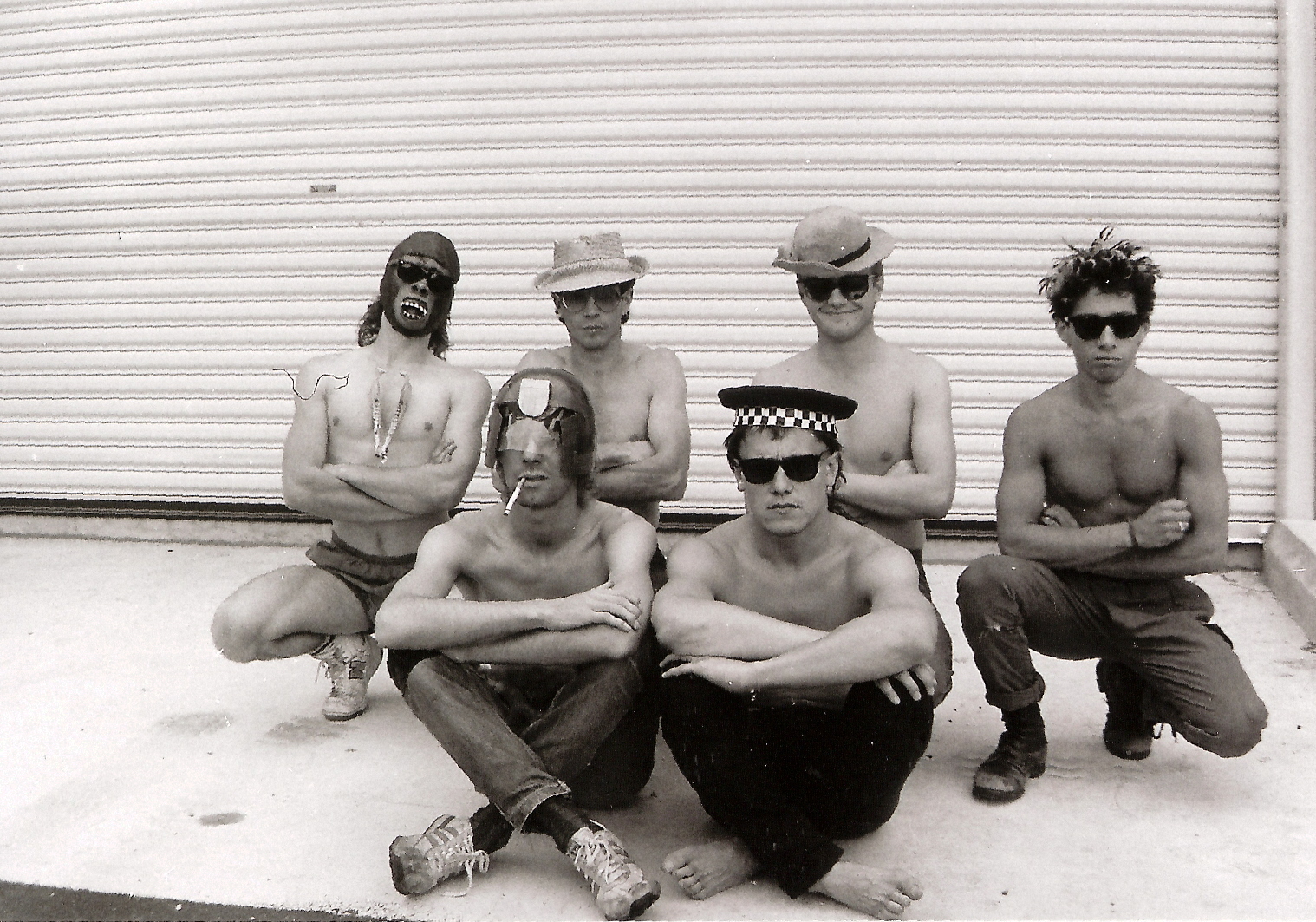
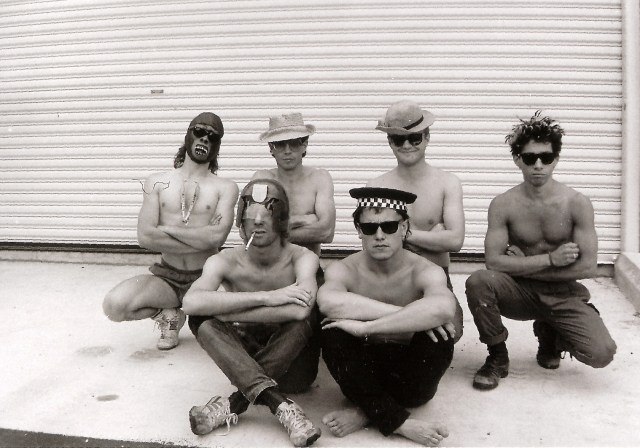
CRITIC – I heard that you all started wearing masks up there whenever you played and if somebody asked for a band photo for an article or something you’d give them a picture of a tree or house or a rock.

BRYCE – Yeah – we always found it hard taking the whole thing seriously . We started trying to separate our ‘real’ personalities from our artistic ones (using fake names and masks etc) so that hopefully people would accept our performances on their face value and not just hate us straight-away – for being a bunch of uppity young wankers.

When I’m on stage I turn into a different person – in real life I’m more reserved – I could never have walked down the street ( well maybe I did occasionally) wearing the sort of bizarre stuff we wore on stage. That’s why so many bands disappointed us – just getting up in their street clothes. and playing their instruments. I always thought there should be clear distinction between the performer and the audience ( although of course you do get the odd interesting exceptions).

DUNEDIN SOUND ON 45

CRITIC – But you did eventually get something out on Flying Nun? – a single with a song called ‘Dunedin Sound on 45’ on one side and your own ‘Uptown Sheep’ on the other. It’s become something of a cult item and still gets quite a bit of play on the student stations. What was the story behind that?

BRYCE – Now that is funny story. One night we were playing at the Captain Cook Hotel ( with The Idles I think or maybe it was one of the ‘Battle of the Bands’) when this guy came up and said we were amazing and he would pay for us to record a single of ‘Uptown Sheep’ at the popular radio station (4X0) where he worked as a DJ. So he jacked it all up and we went down to 4X0 and did it – together with a ‘B’ side called “’I can’t get any sex. I can’t get any drugs, I can’t get any BMX’. Mike was pretty into the whole BMX(Bi-cycle Motor Cross) racing thing then and we all took the piss out of him about it. The recordings were OK but Flying Nun still wasn’t touching us with sharply pointed stick so we still didn’t have a record company – although our mates in the Idles had a good relationship with a Record Company called Jayrem in Wellington.

‘Uptown Sheep/Dunedin Sound on 45’ Cover Photo (Miffy Rees Photo)

At this time (1984/5) there were these terrible songs coming – medleys of perennial chestnuts with names like ‘Hooked on Classics” – all set over a permanent background of incredibly repetitive disco hand-claps – seemingly designed to make anyone with one iota of musical appreciation immediately kill themselves to block out the agony! So – being the little stirrer that I am – I suggested we do our own version and call it ‘Dunedin Sound on 45’. Some of our ‘Dunedin Sound’ musical contemporaries could see the humor in it and actually played many of their parts on the finished song – with us doing all the rest. But many of the local ‘hip priests’ just thought it was another one of our scams (which is naturally was) and didn’t want a bar of it.

Anyway we recorded this thing with Mike Chirnside – two songs by ‘The Clean’ songs, two from ‘The Chills’, and one each from ‘The Stones’, ‘The Verlaine’s’ and part of our own ‘Uptown Sheep’ on the end. Each song segued into the next with that infuriating disco hand clap shit in the background. We also did a dub version of it and recorded ‘Uptown Sheep’ in the backyard at Eric’s county retreat se we could have a double ‘A’ side single.

It eventually came out in 1985 on Flying Nun – 500 copies – no promotion – and someone had butchered (excuse the pun) the cover artwork but over the years its become a bit of a cult classic ( mainly because of the ‘famous’ names that appear on it rather than anything to do with our skill). You’d have trouble finding a copy anywhere for less than $30 now(Editor’s Note – now about $100) and I’ve lost my own copy. I remember I did get a royalty payment from FN once – $40 – I bought these trousers (points).

CRITIC- What prompted the move up to Waiheke Island in 1985? You guys seemed to be going pretty well before you left?

BRYCE- A lot of that was Rob and Barry – you couldn’t play badly with those guys behind you. I moved because I was in love with someone up there and Mike moved because I think he was fed up with Dunedin.

CRITIC – Was it productive?

BRYCE- I think it was – especially in terms of songs and new ideas. We got right into the whole hippy thing and started to examine every aspect of our lives. After one ‘experience’ we decided to totally divorce our real personalities from the band. That’s when we started wearing all the masks and making animal noises when people tried to talk to us and giving them pictures of trees or other objects to print instead of a picture of us. We were so tired of all those geeky band pictures and people saying the same rubbish over and over again. So – we did the ‘More Base’ recording – which does have some good stuff on it – but we had trouble gelling as alive act. The big masks made it hard to play and set up a real barrier between the band and the audience. A lot of people just didn’t get it. And our new rhythm section just wasn’t Rob and Barry – no disrespect to Dick and Dr Yoh – and we had trouble playing good consistent live performances. Mike and I started getting involved in other things – like I got job in an advertising agency through this guy I met on the ferry – and then there was a personal tragedy and the whole thing just disintegrated and I moved back to Dunedin.
LET’S GET NAKED (1986-92)

CRITIC – So when you got back to Dunedin in late 1985 you formed ‘Let’s Get Naked with Rob Murphy.

BRYCE- Before the Naked’s started Rob and me formed a covers band (together with John Fleury/Dixie Tunnicliffe/Nick Bucanan and Antony Baldwin) called ‘Good in Bed’ to play over Christmas and New Year. I love that name – should’ve kept it – I always tried to name bands so that they stood out from the rest on the back page of the Otago Daily Times

If you saw the names – ‘Taste Squad, Rocky Lox, The Shorts and Good in Bed which one might you spend a buck or two on? – if it was me I’d pick the one with the saucy name!

We had a lot of debauched fun and decided to form a new band and write some new songs – so Rob and me got together and wrote most of the songs off the first album in about a month – with him programming the drum machine and playing bass and me writing the lyrics. It started off with just the two of us recording at Mike Chirnside’s place in North East Valley and the first song was ‘Funky Dunedin’. Gradually the band started to grow until we had two front-men – myself and Ross McKenzie (ex lots of bands), Antony Baldwin on guitar (ditto) and Nils Olsen on sax. Later we ditched the drum machine in favor of Riki Agnew (drums)who Rob pinched from Cactus Club to play percussion (until we found out he could drum so well). This was the most stable line-up but there were a few other’s who went through the band at different times including Norman Duftie, Nick Bucanan, Darren Watson, and Robert Steele. It was the best when Riki was drumming but then he buggered off overseas and things slowly began to crap out. We were also really pissed off when the video for ‘Funky Dunedin’ didn’t come out – a long story there….
Let’s Get Naked – 1987
Front Row – Bruce Mahalski/Antony Baldwin
Back Row – Ross McKenzie/Rob Murphy/Nils Olsen/Riki Agnew


CRITIC – So do you think you’ll ever play again?

BRYCE- In 1989 Mike Weston and I re-recorded some Naked’s songs and some that hadn’t been recorded and put them out under the name – Bio-Hazard (before the US band made the name popular). I’d still like to play again with some of the guys – I’m still proud of some of the songs. We just never had that moment when opportunity meets preparation. There were a lot of good bands around at the time – it was a very competitive environment.

I love playing live – when you’re up there and the band is tight and you’re anticipating each others every move and you have this massive a mount of volume behind you – you can feel pretty fucking powerful – like a witch doctor in a cave. But when no–one comes, the PA breaks down, the drummer is drunk – you feel like slashing your wrists. Seriously! But when it works – its amazing – I can put on my stupid out-fit and my sunglasses and pretend to be someone else completely. The day- to-day personality can have a rest and I can let the beast roar! Everyone should try being in a band – there would be a lot less work for therapists….

THE CUDDLY BOMB(1989)

CRITIC – Why did you decide to get into soft – toys – particularly soft representations of nuclear missiles?

BRYCE – It probably had a lot to do with my mum who was a lecturer in animal behavior/child psychology (what’s the difference, right?). One day when I was about 5 she took my favorite soft toy off me and hid it – thinking that it was time I put away such childish things I guess. I don’t remember the incident but it obviously affected her. She spent years afterwards doing research on stuff like childhood attachments to soft toys and blankets to try and find out if children who resorted to such things were more developmentally retarded – in short- they weren’t.

Both my parents were also pretty involved in the peace movement so I was always worried about the world ‘blowing up!’

Anyway –one day a friend of mine – Tony Renouf – was playing around and he made himself a large replica bomb out of cardboard, foil and plastic. We got to talking and I decided that it’d be nice if bombs were cuddly. It took about 18 months to find a place in Auckland that could make them but they’re still not perfect. I want them to be soft yet sharp – which is kind of difficult to achieve. It’s definitely about sending a message to the Super Powers – a sort of cuddly ‘fuck you’ – I’ve even got a giant fake missile in my garden ( courtesy of Grant Skinner who did most of the work on it). So I’m prepared now – anyone stuffs we me and I’ll point my bomb at them! Hear that, Bush! (Editor’s Note – Bush Senior).
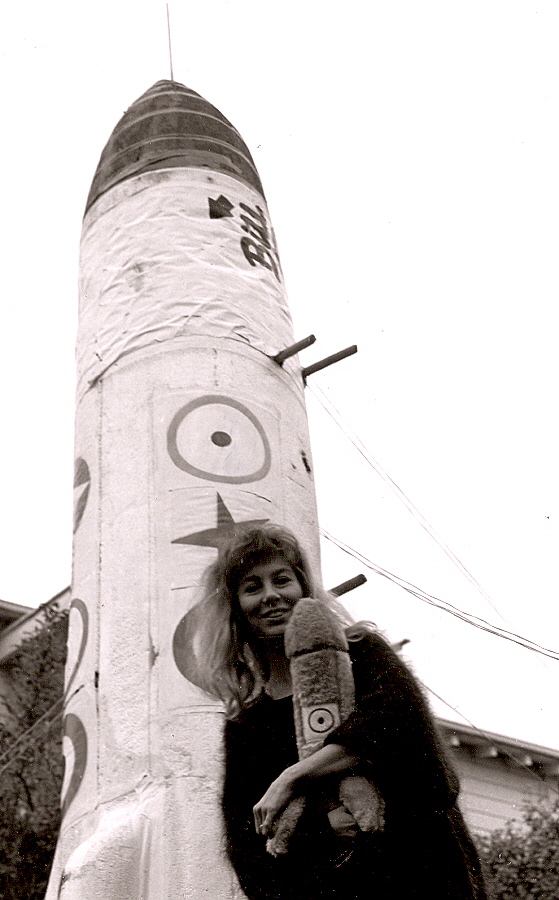
CRTIC –I hear there are different types?

BRYCE- Yeah- you’ve got your two basic colours – grey and white and then you have the air-force insignia of your choice – at the moment you can get American/ Russian/ Kiwi/ Ozzie/ French/British/Iranian and Libyan bombs (best sellers so far). You also get a certificate of ownership with each bomb which explains a bit about the concept.

CRITIC- So what is the concept?

BRYCE- I am trying to make a strong negative statement about nuclear weapons and particularly, their proliferation, as well as attempting to do something positive by giving some of the money raised from bomb sales to the Peace Movement.

CRITIC- Isn’t there a danger that the whole thing will be misinterpreted by the Peace Movement etc?

BRYCE – Sure – stuff like that happens to me all of the time. The main criticisms so far have been that they are too phallic ( look at a missile !!!) and that they ‘endorse’ violence – which is utter crap. (Editors Note – Later there was a big back-lash which effectively put this project out of business – I will try and reprise the cuddly bombs in another blog – there’s quite a bit more to this story including a twenty minute ‘video’ that Mike Weston and I produced to promote the thing – plus local news spots etc.)

POLITICS

CRITIC- Why do you set out to provoke people the way you do?

BRYCE- I guess I just feel that someone’s got to – I see myself as a moderating influence on the worst excesses of our times– if it weren’t for crazies like me harassing them all of the time the politicians would probably go completely over the top and do what they wanted. A lot of people say that the whole ‘peace and love’ thing that happened in the sixties changed nothing and all the hippies turned into lawyers and corporate types. I think that’s just cynical bullshit. If it hadn’t been for that movement at that time the Vietnam War would still be raging and probably the whole of Indo-China through to the Middle East would be series of large smoking holes ( not to mention the rest of the place).

Personally I am always amazed that World War Two ever stopped – perhaps it didn’t – hence the Cold War. I guess I am just driven to live the way I do. In a few years I’ll probably be living in the country and getting into self-sufficiency and other trendy eco- causes. Yep – I can dig it.

CRITIC- It seems suspiciously like you made up the questions to this interview as well as the answers?

BRYCE – Well – yeah!


All writing, images and products Copyright Bruce Mahalski 2009.
Posted in Interviews | Leave a comment