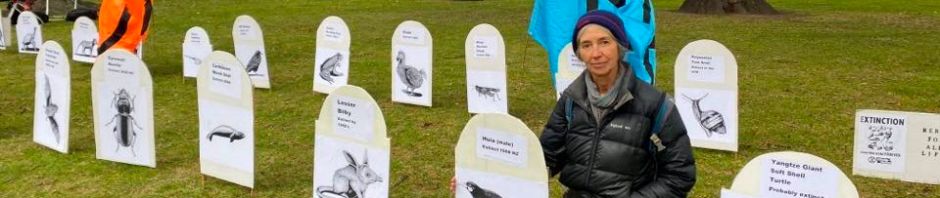
Rosemary Penwarden is a long time climate activist and a tireless advocate for our environment and future generations.
In recent months this brave mother and grandmother has been in the news all over the world for two protest actions highlighting the need for immediate action to arrest runaway climate change but so far the only thing to be arrested is Rosemary herself!
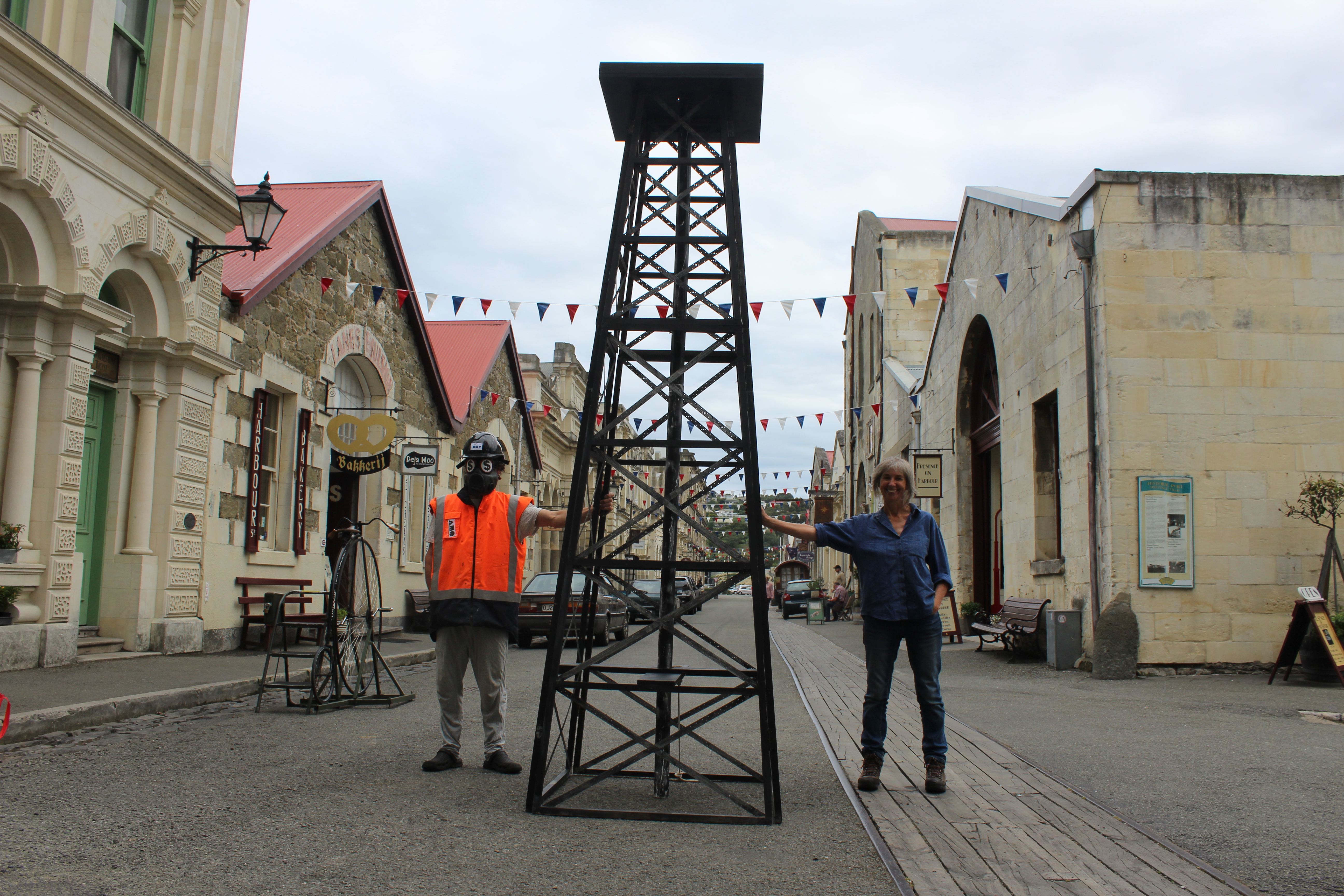
The first recent noteworthy event was a jury trial in June(2023) at the High Court in Dunedin where she was found guilty of two charges for sending a fake email ‘cancelling’ the annual Petroleum Exploration and Production Association of New Zealand (PEPANZ) conference in Queenstown in 2019. Despite the email being a pretty obvious joke with sentences like –
“Our only recourse at this point is to completely reassess our approach to the basis of our industry, petroleum… But there is a silver lining to all of this: we will not be there to listen to that incessant chanting (i.e. – from protesters) “
The conference went ahead as usual but Rosemary was still convicted of two charges. One of ‘forgery’ and the other of ‘using a forged document’ with the latter carrying a maximum penalty of 10 years’ jail. She has applied for a discharge without conviction and will be sentenced in September 2023.
The second event was for allegedly endangering transport on State Highway 1 in Kilbirnie in Wellington in late August(2023)when she(together with three other protesters from the group – Restore Passenger Rail) blocked the road with signs and their bodies. This is not her first offense for blocking traffic in the capital at previous RPR actions and she was the only one out of multiple fellow protesters to be declined bail and is currently remanded in custody until September 11th. The charge of ‘endangering traffic’ is a serious one which carries a maximum sentence of 14 years’ imprisonment.
So who is this trouble-making grandma and why does she seem so keen to go to jail?
————————————————————————————————————————
Rosemary was born in Whanganui in 1959 as part of a pretty typical Kiwi family.
Her dad was a dairy farmer and her mum a nurse before marrying and caring for their seven children. Rosemary, child number five, was the self described ‘runt of the litter’. She credits her father for passing on to her his love of nature (he was probably one of the first dairy farmers to put his small piece of lowland forest into QEII Covenant) and her mother for her unconditional love. Her Primary School Teacher, Mr Taylor, is cited as another strong influence, who, unusually for both the profession and period, taught the young Rosemary to question both authority and its legitimacy.
Like many seventies youngsters she left school at the tender age of sixteen and went straight into a job working for the local hospital as a lab technician. Three years of work and study between Whanganui Hospital and the Central Institute of Technology led to a Diploma in Medical Laboratory Technology (Paramedical), then she moved to Upper Hutt to work as science technician and scientific officer in the research virology lab at Wallaceville Animal Research Centre.
It wasn’t long before Rosemary was infected by a bug herself, the ‘travel bug’, and embarked on an extended overseas sojourn travelling via North America, Canada, Mexico and Central America to the UK and Europe. On her return to New Zealand in 1983 she began a Bachelor of Arts degree at Auckland University majoring in Spanish. It was around this time Rosemary developed a lasting interest in Buddhism, yoga and Eastern philosophy. She followed this interest to the far north in 1985 to caretake a property and log cabin near Kaitaia owned by a yoga group “Star of Asia”. A year later, back in Auckland, Rosemary’s first child, Arani was born (a Hindu name meaning ‘one who illuminates others’). It was an inspired choice of name; Arani grew up to become a primary school teacher.
In 1988 Rosemary and Arani moved to Waitati (a tiny coastal community north of Dunedin) which instantly “felt like home, surrounded by nature and like-minded people.
In 1990 her second child, Jesse was born and when he was three Rosemary returned to full time study to finish her Diploma in Medical Laboratory Science at the Haemotology lab at Dunedin Hospital where she worked for the next thirteen years. She became a local representative on the National Executive of the Medical Laboratory Workers Union, fighting for humane working hours and better working conditions for her colleagues. These activities fostered an expanding passion for equality and social justice.
When the Dunedin Hospital laboratory was privatised in 2006 she was offered a job as Delegate Support Officer for Contract Negotiation Services, a company that offers union support to laboratory workers, resident doctors, radiographers and other health professional groups.
The year, 2011, was pivotal for Rosemary for two reasons.
“The most amazing moment of my life was watching my daughter give birth to my grandson. He will be 39 in 2050 when the government has committed to being net zero carbon. All of a sudden climate change became real and personal for me. A lot of what I do now, I do for Arlo and his sister, Adaline.
The second was the visit to Dunedin of a NASA scientist, James Hanson. He had just published a groundbreaking paper entitled “Global Surface Temperature Change” describing recent advances in global temperature analysis which clearly pointed to a dangerously uprising trend in world wide temperatures. Increased evidence of more warming in the more industrialised northern latitudes provided strong evidence this warming was anthropogenic (human caused) in origin.
Shortly afterwards Green Party co-leader, Jeanette Fitzsimmons, also visited the city and gave a talk about Solid Energy’s plans to create a massive lignite mine in the Mataura Valley. Solid Energy’s plans included a lignite-to-briquette plant, a lignite-to-urea plant and a lignite-to-diesel plant, in all adding up to 20% to New Zealand’s greenhouse gas emissions and destroying the Mataura Valley and its close knit farming community. Fortunately a fall in the price of coal and resistance at both local and national levels scuppered the project.
Rosemary began to have serious concerns about the implications of unchecked development and climate change for her young grandchild’s future. Would there still be a habitable planet for him when he grew up to have children of his own or would the planet have become a toxic wasteland? It was at this point she decided to devote the rest of her life (no matter what the personal cost) in the pursuit of environmental and social justice.
“I can’t think of anything more useful for a grandmother to do than to highlight the need for us all to get a little bit uncomfortable to try to save a viable future for our children,” she said.
One of the first things she did was to join CANA (Coal Action Network), a group formed by people who already had considerable experience working for the ‘Save the Happy Valley Coalition’. This was a sadly unsuccessful campaign to thwart the creation of an open cast coal mine on the West Coast of New Zealand.
CANA’s position is that the mining and burning of coal is the primary threat to Earth’s climate system.
One of Rosemary’s first actions was to write a booklet opposing the Mataura Valley Lignite Mine, “Just Lignite”, which was paid for by the Anglican Church. After over thirty thousand copies were distributed and the campaign had a successful result Rosemary felt some confidence that she had some positive skills to offer the movement. In fact today she still regards the public outreach she achieved with this publication as one of her biggest ‘environmental’ successes.
Since then Rosemary has been an active participant in a number of other groups, particularly ‘Oil Free Otago‘, ‘Extinction Rebellion‘ and more recently, ‘Restore Passenger Rail.’.
In 2019 she was one of a group of protesters who demonstrated outside the 2019 Petroleum New Zealand Conference in Queenstown (as already mentioned) and in November of that year she was among 30 protesters who boarded OMV’s support vessel Skandi Atlantic. OMV are a huge multi-national company whose giant mobile rig, the COSL Prospector, had just completed its drilling programme for oil and gas off the South Otago coast at the time. Luckily they didn’t find any!
Rosemary is always thinking about ways to reduce her negative impact on the planet and in 2016 took the radical step of converting her old 1993 Honda City to a fully electric vehicle.
It was an expensive and time consuming project but she wanted to prove it could be done and that we can use materials we already have available to reduce our ecological footprint. She did quite a bit of the work herself alongside a team of more experienced locals at the Valley Community Workspace (VCW) in North East Valley, Dunedin, which she helped to set up with a small team of like-minded locals. Today VCW is buzzing with activity with electric bike sales, building household and industrial sized battery packs, solar installations and the retrofitting of vehicles from bikes, cars, utes and even buses. Rosemary has remained President of VCW since its inception. Walking in there reminds her of the smell of her father’s implement shed on the farm.
“I love the place. In different circumstances I might have turned into a petrol head myself! I loved working on the car and coming home all greasy! I got a lot out of doing all that work and I’m proud to be part of a project where people are learning new skills and new jobs are being created using existing resources. ”
Rosemary isn’t saying everyone should try and convert their car to electric. She would rather see more public transport and people walking or riding a bike for short journeys.
Like quite a few other environmentalists she has stopped flying altogether.
“You might want to avoid me at parties if you’re planning to talk about, say, your next trip to Bali. Conversation-stopper or not, I will tell you that I believe the climate scientists; I’m terrified for my grandchildren’s future and that’s why I’ve stopped flying.”
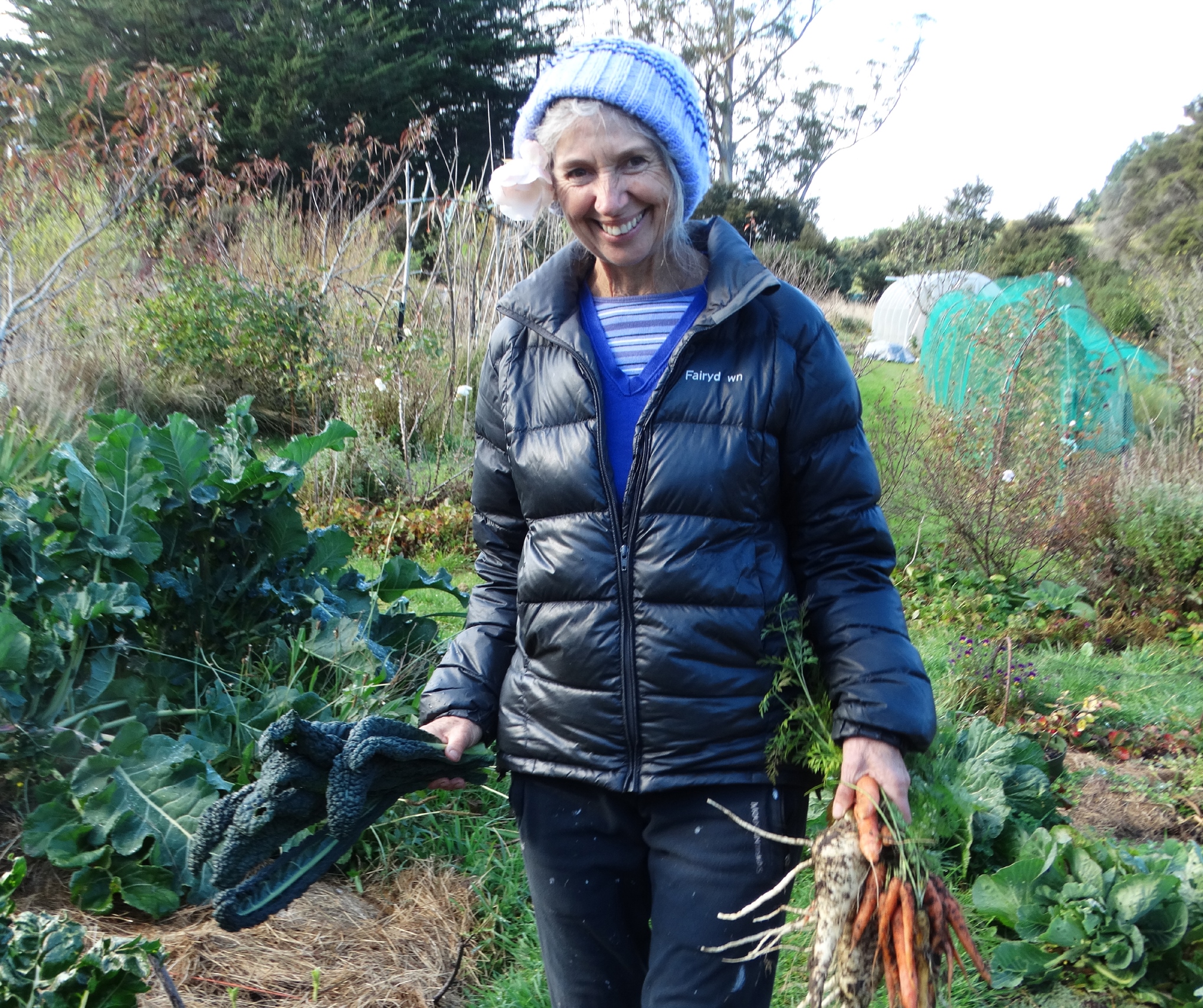
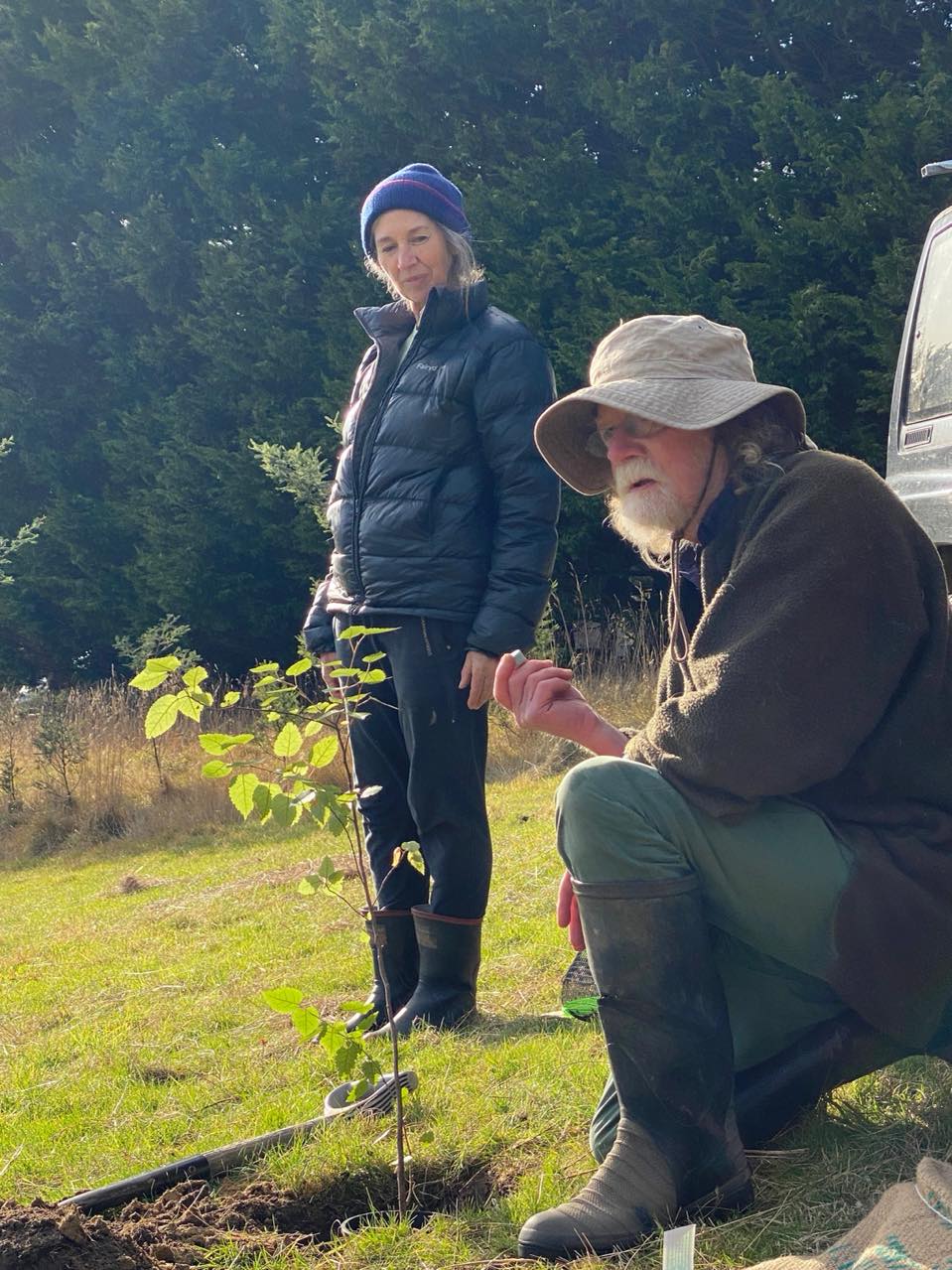
In recent years Rosemary and her partner Derek Onley, ornithologist and widely published illustrator, spent nine months in a caravan while their small 50 m2 house was being built on a four hectare lifestyle block near Dunedin. Now complete, the building was made with local and mostly untreated timber and is insulated with shredded milk bottles. Twenty-seven solar panels on the hillside above the house connected to a battery system put together by Rosemary herself (configured in the same way she learned to configure her car batteries) provide all of the power the property needs, including charging “Freda”, the electric Honda City. All of the houses’ grey water is captured on site and there is also a composting toilet. Thousands of trees have been planted on the property to try and help to off-set the family’s negligible carbon footprint including two apple orchards, a hazelnut orchard and a large vegetable garden.
You might think carrying all that environmental angst would make Rosemary quite a sad person but the opposite is true.
She has turned the climate crisis into an opportunity to push herself to her limits in the remaining years of her life. She’s an extremely vital person who’s usually smiling and offering you a cup of peppermint tea with one hand and some kai from her garden in the other.
“Despite all of the doom and gloom of the scientific projections I do feel some sense of optimism for the future and that’s mainly because of all the amazing young people I work with in the climate movement.”
“It’s a weird thing, but to know the worst about the future and yet to face it without flinching, without turning away, can give you enormous strength.”
“I’m a naturally positive person and the climate crisis has taught me that positive doesn’t mean avoiding the bad stuff. Sometimes forcefully (but peacefully) saying no to the things that are threatening our future, together with others who care as much as you, can be the most positive thing you can do.”
“I love what Bill McKibben, author and co-founder of the climate organisation 350.org, says about this:
“Very few people on earth ever get to say: “I am doing, right now, the most important thing I could possibly be doing.”


 Mahalski