
I live close to a local port town which is often visited by cruise ships coming from Australia and other places. In the most recent season (October to April) there were over 120 visits. Some of these ships are absolutely massive with around 4000 passengers and 2000 crew.
Like many other people I’m very concerned about the gigantic carbon footprint of the industry as well as its impacts on local water supplies, air pollution, public health and transport. With all of this in mind, I helped to organize a public meeting to discuss the issue just after Easter. Around 40 local people attended and there was a robust discussion. However some people get very upset if you even mention cruise ships and if you dare to post anything on the local Facebook page (even a poster advertising a meeting) some people start jumping up and down and throwing insults. Quite a number of them believe they know a lot more about climate science than any of the so-called experts.
Here are a few comments, and my replies, to and from a local resident who hit back at the my post advertising the talk (see poster below) with a link from ‘The Daily Skeptic’ saying that arctic sea ice is expanding. I guess it goes to show that a little knowledge can be a dangerous thing. NB. I have left all of the spelling and punctuation unchanged.
——————————————————————————————————————–
Resident – Posted a link saying artic sea ice is expanding.
Me – The Daily Skeptic is not a scientific journal and Chris Morrison is not a scientist. I could martial evidence from all sorts of non- scientific websites to prove the world is flat but it’s not.
Resident – can you please show me the paper that shows co2 it the climate driver as I can’t find it
Me -Thank you for your interest. There are probably over 100, 000 of them. Which one would you like?
Resident – the one that takes the hypothesis that more co2 in the atmosphere will lift temperature and proves it with tests
Me – Thank you for your comment. I will try and answer it as best I can- Before the Industrial Revolution began in the 19th century there was a ‘natural’ carbon cycle with animals taking in oxygen and producing CO2 during the process of respiration . At the same time photosynthesizing plants were taking in CO2 and releasing oxygen. Much of the carbon the plant takes in during its lifetime is fixed in its body of the plant when it dies. In very basic terms this is the natural carbon cycle which of course continues the same way today. Humans changed the game when they started digging up lots of long dead plants ( some of which had turned into oil and coal etc) and burning these carbon rich fuels in huge amounts and thereby adding lots of extra carbon to the cycle. At the same time we were busy chopping down lots of trees and deforesting huge areas. There is now way to much CO2 for existing plants and plant plankton to ‘mop up’ and all the excess carbon in the atmosphere is absorbing and reflecting heat – much of which goes into the ocean where it affects global temperatures and weather patterns.
Resident – your a sheep and an idiot to believe there bull shit show me the proof
Resident – and again if carbon dioxide is the problem plant more trees cause there real good at turning it into oxygen and funny how there’s trees thriving in places they haven’t for a long time and the recent ice samples that have come to light from millions of years ago when there was more CO2 in the atmosphere carbon dioxide isn’t the problem people like you who buy the bullshit the msm Is feeding people are the problem.
Resident – Wheres your scientific evidence that oil is from plants ? And how did that get thousands of feet under ground? fossil fuel is one of the biggest lies told to humanity and wasn’t global warming originally because of the hole in the ozone layer! oh that’s right that got debunked so they changed that to CO2 and that’s not possible ever. How can a plant turn into oil? That would have to be some pretty magical stuff going on under ground. Again show us the test’s that they have done to prove this is happening not just the hypothesis that CO2 is doing what you say. The only thing that is going on with this whole climate change bullshit is inflation is going up and where paying more taxes and there’s people making billions of dollars out of it. Wake up to there bullshit and stop being part of the problem! electric cars charged by coal power plants? And said cars are now proven to be worse for the environment then any petrol car! just the mining alone is worse let alone the moving of said ore all over the world to turn it into batteries and then when the battery fails there’s no way to dispose of it that is environmentally friendly the whole thing is one big scam and will be the death of millions of people especially if we stop farming have a look at what’s going on in Europe and how the farmers are protesting! The WEF the WHO and the UN should be classified as terrorists for what they are trying to in-force on humanity. And the people who are telling us where the problem driving around in our cars are flying all around the world in there private jets and buying up ocean front property’s hmmm aren’t they telling us the sea levels are going to rise does that make any sense to you?
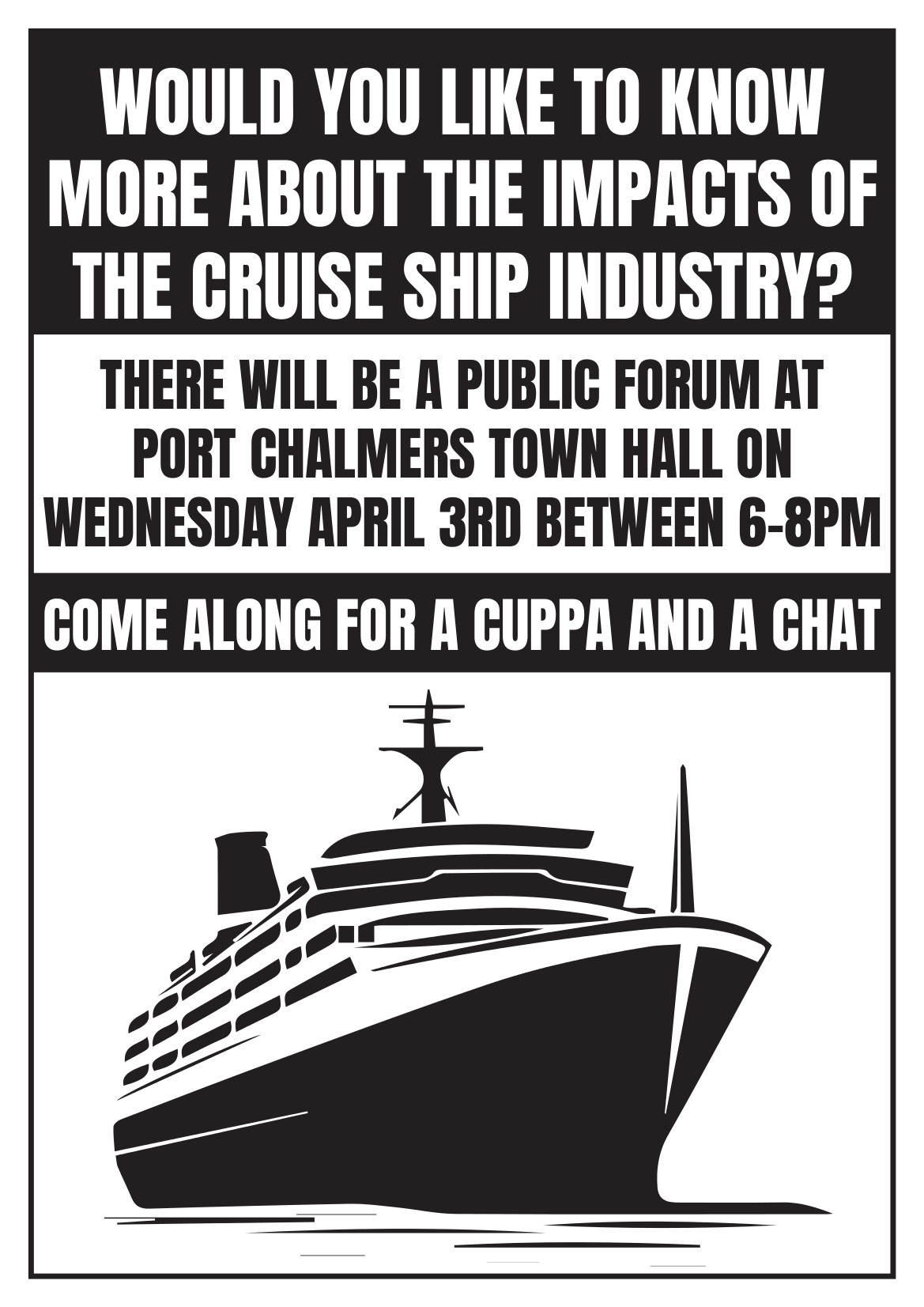
This is the poster advertising the talk I posted. Like previous posts it garnered over 100 comments but I had to take it down when it devolved into an insult fest. Why is it so hard to have a normal conversation on Facebook? I have added some information about the impacts of the cruise industry below.
Cruise ships book up to five years ahead.
Port Otago CEO, Kevin Winders, says they are not a huge part of Port business, which makes more money from containers and log ships but he admits the cruise ships pay the highest dividend. It should be noted that the Port is owned by the Otago Regional Council – our environmental stewards.
In the most reason season over 100 cruise ships came to Dunedin – either Port or the city.
Thirty-five people are employed six months a year to dock/undock plus customs
Kevin Winders estimates that the cruise industry adds some $70million to the city’s economy every year. In the 12 months to June 2019, cruise ship spending throughout the country was $570 million from 322,000 passengers. There is no information regarding spending by the crew.
A 2017 study found that while cruise ship tourists made up around 13% of visits in the preceding year they only contributed to around 3% of the spending.
A new study is taking place at the moment led by Prof James Higham (Co-editor of the Journal of Sustainable Tourism) which is being paid for by DOC on behalf of the Milford Opportunities Group.
2)MARINE CARBON EMISSIONS
A DCC spokesman noted the Dunedin community carbon footprint in 2021-22 identified marine freight as generating 10% of Dunedin’s gross emissions and 31% of transport emissions.
Marine emissions are primarily generated by the movement of vessels to/from Port Otago. Port Otago is export-dominated, with imports mainly being bulk fuels. Most of the freight exported through the port originates from Clutha and Southland. The most significant volume of exports originating from within the city’s boundaries is logs. For most vessels, Port Otago is their first or last port of call in Aotearoa New Zealand.
Cruise vessels aren’t currently included in Ōtepoti Dunedin’s emissions footprint due to ‘data limitations’ (according to Port Otago) but the number of cruise vessels calling at Port Chalmers suggests they are a significant source of emissions for the city.
We need to ask that these emissions are calculated and included in the city’s Carbon Zero 2030 plan.
3. AIR POLLUTION
In 2020 Port Otago started to measure air quality at its Port Chalmers base after complaints from the public and to new regulations from the International Maritime Organisation (IMO) regarding the Prevention of Air Pollution from Ships.
The ongoing monitoring is being done by Plume Labs at a site up on the hill. There is a website where you can read live reports of Real-time levels and forecasts of Particulate Matter (PM2.5, PM10), Ozone (O3) and Nitrogen Dioxide (NO2) in Dunedin.
https://air.plumelabs.com/air-quality-in-port-chalmers-aw-249931
Fair (which it is today)means that the air is moderately polluted. This is greater than the maximum limit established for one year by WHO. A long-term exposure constitutes a health risk. Poor means the air has reached a high level of pollution and is unhealthy for sensitive groups and to limit your time outside.
New Zealand signed up to Annex VI of the International Maritime Organization (IMO) Convention for the Prevention of Pollution from Ships (MARPOL) on 26 May 2022. MARPOL has six annexes categorised by pollution type. Annex VI of MARPOL seeks to address the impact of air pollution from shipping activities on human health and environments in and around port communities, and the impacts of emissions from shipping activities on climate change and ozone layer. Some of these regulations (the ones around Port Air Quality) came into force in NZ law starting from August 2022 but I am still trying to find out exactly what they are. So far nothing seems to be happening regarding legislation around the effects of shipping industry and climate change – just talk.
Prior to this there were no regulations about air quality at NZ ports.
Cruise ships recently stopped using fuels containing sulphur oxide and this is a step in the right direction. Their scrubbers have also improved but all the nasty stuff these scrubbers catch still has to go be stored on land.
4.WATER RESTRICTIONS
Recently there were water restrictions in the West harbour and local reservoirs are hitting rock bottom.
While the ships do have desalination plants on board for producing drinking water they still pump on thousands of gallons of water at local ports for showers and cleaning etc.
The average cruise ship can use around 8,000 gallons of fresh water PER HOUR (about 200,000 gallons (700,000 litres) per day ). Larger ships can use over half a million gallons per day.
For quick math: average passenger uses about 150 gallons per day, so the ship in the photo here (Celebrity Edge, 3,000 passengers) uses about 450,000 gallons of fresh water PER DAY, just for the passengers.
The two largest water treatment plants, Mount Grand and Southern, supply most Dunedin customers. The Port Chalmers water treatment plant supplements the water supply during the cruise ship season (October to April). Waikouaiti, Outram and West Taieri also have small treatment plants. (DCC website).
During normal operations, Port Otago accounts for about 2% of water usage in the Port Chalmers area, but this can increase significantly – to between 20% and 30% – when they provide water to cruise ships.
It’s true that not every cruise ship who visits Dunedin takes on water and in light of our recently implemented restrictions Port Otago have confirmed they will only supply vessels with water if the need is urgent while our water restrictions remain in place.
Some figures
Last cruise season (2022/23) cruise ships in Lyttelton port took on ~6750 tonnes of freshwater in total. 1/3 of cruise ships took on water (79/3) at an average of 250 tonnes each.
This equates to what all Lyttelton (incl Rāpaki, Cass and Corsair) households would use over 11 days*).
In Port Chalmers water use was supposedly much higher and it has been suggested it was over 70,000 cubic metres (or the same amount in metric tonnes) during the last calendar year. This is a lot more than in Lytellton!
Yes – the DCC gets paid for this but it’s the local residents who are subsidizing it.
Port Otago is a commercial customer and the DCC meter and bill them for their water usage, including the water they supply to cruise ships, as per our Water Bylaw.
5. TRANSPORT
We all know there is pressure on the local bus network when there are cruise ships in town and many passengers go on excursions using Ritchies Buses (as well as with other companies) and this is a significant source of emissions in itself, particularly when the buses keep their engines on all the time to run the air conditioning.
There is also the issues of Dunedin Railways (which is owned by the DCC) bringing trains out to the ships so passengers can go on excursions such as the Taeri Gorge Rail Trip. Local rate payers have subsidised the maintenance of this railway line for no benefit to themselves when there is a perfectly good rail line going from Port to Dunedin. Why can’t Dunedin railways trial a morning and evening service five days a week for the benefit of local people instead of just catering for well-heeled visitors.
—————————————————————————————–
6. What we want locally
1) An independent study to calculate the carbon footprint of the industry – both locally and nationally. This is not just the ship movements themselves but all of the other emissions created by the industry such as building the ships themselves as well as flying passengers to and from and ships and driving them round at each port.
2) An independent study of the amount of water taken on by cruise ships while in port (Note- A cruise ship will bring fresh water onboard when they visit ports. However, this water is not for drinking. This water is used for laundry, as ballast, or to cool the engines. Water used for drinking is usually taken from seawater undergoing a desalination process.) Is this level of water uptake sustainable?
(3) We would like to see these emissions added to Dunedin’s Zero Carbon Budget 2030 along with other local marine emissions. Port CEO Keven Winders has already said he wants to keep these emissions out of the city’s carbon zero plan.
4) We would like an appropriate carbon tax added to all ticket prices to help buy local (not overseas) carbon credits to help off-set these emissions.
5) We would like to discuss halving the number of large cruise ships visiting the port in the 2024-25 season to help take some pressure off the local environment and infrastructure while studies are being done and negotiations are taking place to address these issues
7) We don’t want them going to Milford Sound as an oil spill there would be a huge ecological disaster in this very sensitive area. It is already suffering from the effects of climate change – in June 2022 unusually warm water killed millions of sponges , as well as killing thousands of corals. Cruise ships are a major contributor to climate change.
GENERAL POLLUTANTS FROM CRUISE SHIPS
Pollutants and waste from cruise ships include air emissions, ballast water, wastewater, hazardous waste, and solid waste. An average cruise ship generates a minimum of 1 kg of solid waste plus two bottles and cans per passenger per day and an average of 50 tons of sewage (black water) per day. A figure of 3.5 kg/passenger/day, with the estimated amount of generated waste (typical one-week voyage) including 25,000 gallons of oily bilge water; 210,000 gallons of sewage (or black water); 1 million gallons of non-sewage wastewater from showers, sinks, laundries, baths, and galleys (or grey water) and eight tons of solid waste (i.e. plastic, paper, wood, cardboard, food, cans, glass).
The average cruise ship of 3,000 passengers and crew generates about 50 tons of solid waste in a single week. These vessels, or the ones with double capacity (i.e. the Royal Caribbean Oasis-class vessels that exceed capacities of 6.000 passengers), cruise with a capacity utilization that exceeds 90%, thus producing significant wastes and residues to be delivered at the cruise ports they visit.


